Federation of the Democratic Left

Intertwined paths, a renewing Left

Floods in Ksar El-Kebir: Abdeslam Al Aziz Warns that "Displacement into the Unknown is No Solution" as the City Appeals for Relief The FDL
04 Feb, 2026

Floods in Ksar El-Kebir: Abdeslam Al Aziz Warns that "Displacement into the Unknown is No Solution" as the City Appeals for Relief

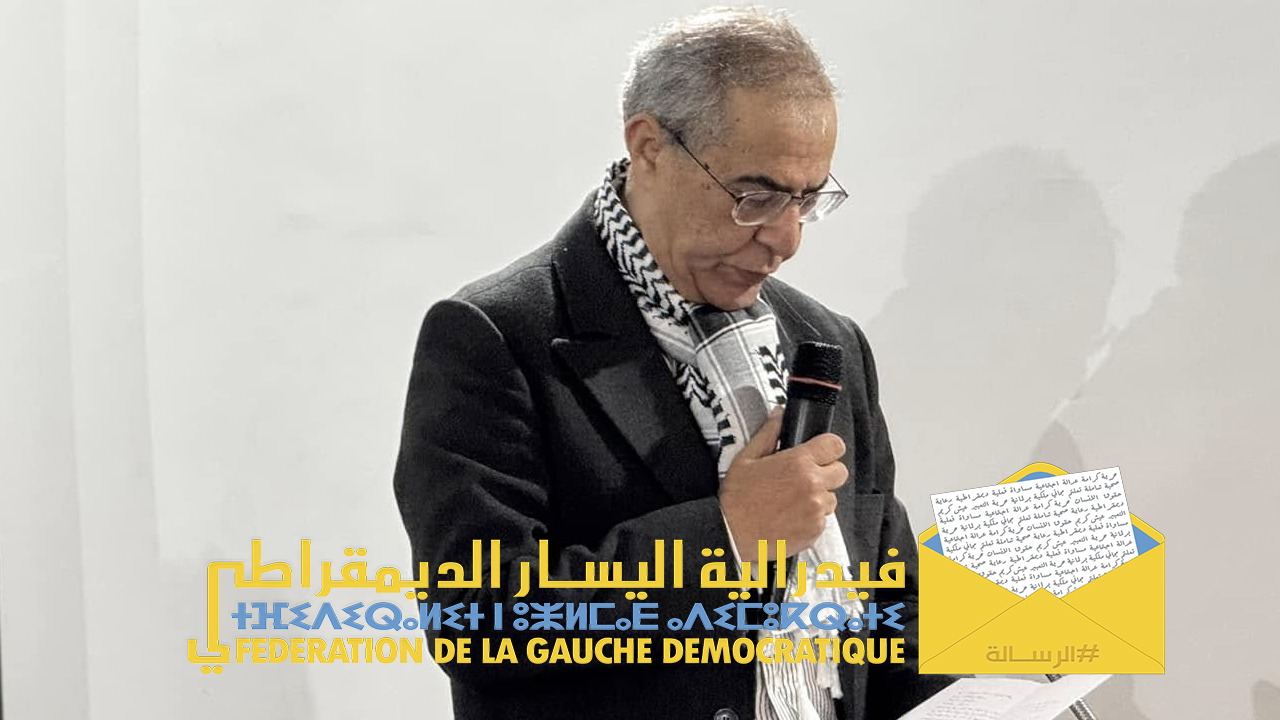
Floods in Ksar El-Kebir: Abdeslam Al Aziz Warns that "Displacement into the Unknown is No Solution" as the City Appeals for ReliefAbdeslam Al Aziz, Secretary-General of the Federation of the Democratic Left (FDL), issued a formal statement regarding the devastating floods currently affecting the city of Ksar El-Kebir. He warned of the severity of the situation and its humanitarian and social repercussions, describing the current moment as critical and fraught with unprecedented risks to the population.Critique of Emergency Evacuation ProceduresReflecting on his personal history as a native of the city who witnessed the historic floods of 1963 and 1971, Al Aziz asserted that the magnitude of today’s challenge transcends mere warnings or the assignment of blame. He emphasized the necessity of responsible and rational management, cautioning against "hasty and abrupt emergency measures" that mandate immediate evacuation without adequate preparation, as such actions exacerbate public panic.The Secretary-General argued that demanding residents vacate their homes without providing a secure destination or guarantees regarding the safety of their property is unacceptable. He underscored that "displacement into the unknown" cannot constitute a viable solution, regardless of the severity of the circumstances.Constitutional Obligations and State ResponsibilityWhile Al Aziz acknowledged the positive efforts of various state institutions in preventing casualties and establishing temporary shelters, he maintained that these initiatives do not absolve the State of its sovereign duties.He specifically cited Articles 21 and 31 of the Constitution, which stipulate that ensuring the safety of citizens and providing the conditions for a dignified life are fundamental constitutional obligations of public authorities. This is particularly urgent given that the disaster threatens approximately 125,000 citizens, many of whom live in conditions of precariousness.Proposed Legal and Logistical FrameworksFollowing the announcement of the total evacuation of the city, Al Aziz called for several urgent legal and logistical interventions:Activation of Law No. 110.14: The immediate implementation of the legislative framework establishing a system for managing catastrophic events.Declaration of a "Disaster Zone": Formally designating Ksar El-Kebir and its environs as a disaster area to mobilize necessary financial and logistical resources.Utilization of Public Infrastructure: Opening all public and semi-public summer resorts in northern cities—currently closed—to house displaced families.Private Sector Engagement: Partnering with the private sector to provide alternative spaces that uphold the dignity of the affected population.Economic Impact and Social ProtectionThe Secretary-General drew attention to the dire economic consequences facing approximately 33,000 families. He noted that many workers, traders, and artisans will lose their livelihoods due to the prolonged suspension of economic activity.He stressed that protecting lives begins with shelter but is only fulfilled by ensuring food security and a dignified income, arguing that "there is no room for improvisation" in the face of such heavy responsibility.Al Aziz concluded his statement with a call for collective and responsible mobilization, placing human dignity and safety as the absolute priorities in confronting these natural tragedies.
Read more
Federation of the Democratic Left in France Reiterates Opposition to Normalization and Calls for Political Decongestion in Morocco The FDL
03 Feb, 2026

Federation of the Democratic Left in France Reiterates Opposition to Normalization and Calls for Political Decongestion in Morocco

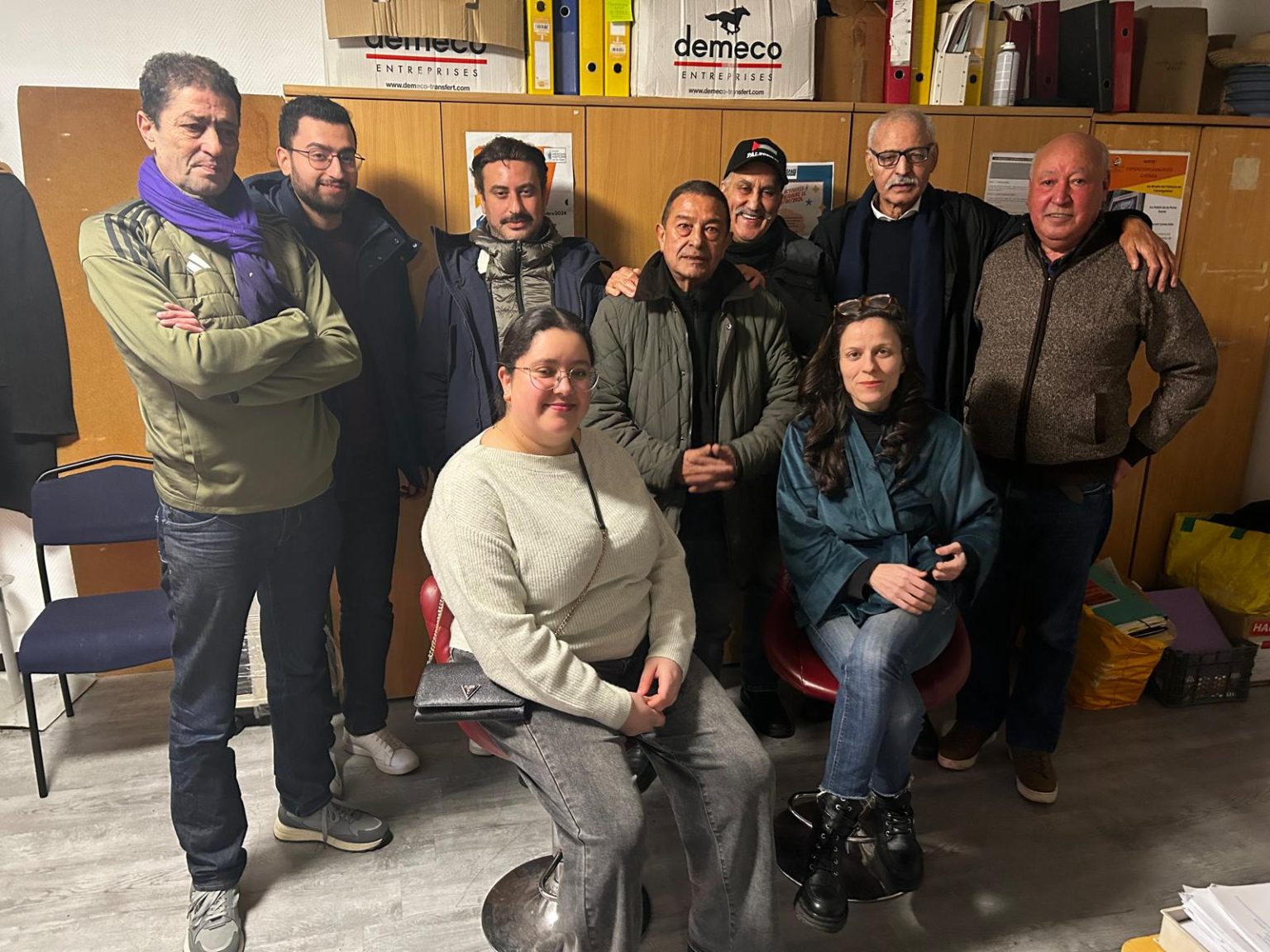
Federation of the Democratic Left in France Reiterates Opposition to Normalization and Calls for Political Decongestion in MoroccoThe Regional Council of the Federation of the Democratic Left (FDL) in France issued a statement following its meeting held on January 31, 2026, in Paris. The session was convened under the theme of commemorating the 60th anniversary of the abduction and assassination of martyr Mehdi Ben Barka and the 50th anniversary of the assassination of martyr Omar Benjelloun. The council deliberated on international, regional, and national developments, concluding with a firm political stance on several contemporary issues.The Palestinian Cause and NormalizationThe Regional Council reaffirmed its unconditional support for the Palestinian people, praising their resilience against what it described as the "Zionist war machine" and Western imperialism. The statement asserted that the Palestinian people and their resistance factions hold the sole right to self-determination and the establishment of an independent state with Jerusalem as its capital. Furthermore, the council strongly condemned the crimes committed in Gaza and the West Bank—including killing, forced displacement, and the destruction of civilian infrastructure—while demanding an immediate cessation of normalization between Morocco and the Israeli entity, arguing that such ties legitimize the occupation.International Affairs: Venezuela and SudanOn the international stage, the council denounced what it termed "American imperialist aggression" against Venezuela, following military strikes and the detention of President Nicolás Maduro. The statement characterized these actions as a flagrant defiance of international law and popular sovereignty. Expressing absolute solidarity with the Venezuelan people, the council argued that the intervention aims to seize oil, gas, and mineral resources while subverting a progressive national government.Regarding the crisis in Sudan, the statement condemned the atrocities committed against the Sudanese people. It held the Rapid Support Forces (RSF) and other military factions accountable for what it described as war crimes and crimes against humanity. The council called for an immediate ceasefire, the establishment of safe humanitarian corridors, and a democratic transition that aligns with the objectives of the Sudanese revolution.National Affairs and Social JusticeAt the national level, the council declared its solidarity with the demands of the "Generation Z 212" movement and the broader Moroccan populace. It called for an immediate response to demands for dignity, social justice, and a fair distribution of wealth, emphasizing the right to healthcare, education, and employment. Additionally, the council condemned the rise of hate speech and racism against migrants, particularly those from Sub-Saharan Africa, warning that scapegoating entire groups for isolated incidents poses a societal danger.Sovereignty and Political ReformWhile noting that the latest UN resolution on the Sahara constitutes a step toward consolidating international recognition of national sovereignty over the southern provinces, the council emphasized that such sovereignty must be linked to "popular sovereignty." It advocated for the construction of a truly democratic state based on the rule of law and social justice. In this context, the Federation called for a comprehensive political decongestion (infraj), starting with the immediate release of all political prisoners, including activists from the Hirak Rif, journalists, bloggers, and human rights defenders.
Read more
Abdeslam El Aziz: Migration is the Result of Policy Failure, and Colonial Borders Create Tragedies The FDL
03 Feb, 2026

Abdeslam El Aziz: Migration is the Result of Policy Failure, and Colonial Borders Create Tragedies

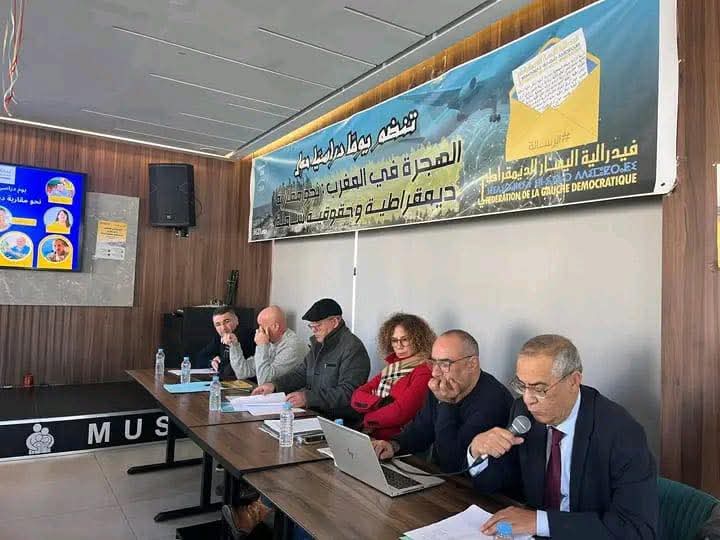
The Symbolic Choice of M’diqDuring a national study day on migration held on January 24, 2026, Abdeslam El Aziz stated that the choice of M’diq for this event was not neutral. It was a politically significant decision: the city, located just a few kilometers from "occupied" Ceuta, illustrates the gaping chasm between a marginalized South and a fortified North. For him, this region is a theater of human tragedies where Moroccan youth, driven by unemployment and a lack of prospects, risk their lives against barbed wire or at sea.Sovereignty and Colonial BordersThe Secretary-General of the FGD reaffirmed the party's consistent position: Ceuta, Melilla, and the adjacent islands are occupied Moroccan territories.A Persistent Colonial Legacy: These enclaves are not merely historical vestiges, but a political reality that undermines national sovereignty.Flashpoints of Tension: These borders transform the region into zones of permanent conflict and contribute directly to migratory tragedies.Liberation and Democracy: The "liberation" of these territories is inseparable from the struggle for democracy, spatial justice, and the construction of a Mediterranean space based on cooperation rather than militarization.Critique of International and European PoliciesAbdeslam El Aziz lambasted the current international climate:The Rise of the Far-Right: The hardening of European policies and racist rhetoric are turning the Mediterranean into a "mass grave."The "Border Guard" Role: He refuses to let countries of the South, including Morocco, bear the cost of the international system's failure by becoming mere "border guards" for Europe.A Multidimensional Crisis: Migration is no longer a simple social phenomenon; it is the symptom of a profound political and economic crisis.The Multiple Faces of MigrationThe intervention highlighted two major aspects of the migratory crisis:Irregular Migration: Described as a "cry of protest" against marginalization and the lack of social justice.Brain Drain: A "dangerous hemorrhaging" that drains the country of its doctors, engineers, and researchers.Moroccans Living Abroad: New generations face increasing discrimination and are deprived of full citizenship.Reception in Morocco: El Aziz also pointed to the legal and social precariousness of migrants and refugees within Morocco, arguing that it does not befit a state that claims to place human rights at the heart of its policies.Against Hate SpeechA serious warning was issued regarding the rise of hate speech and racism in Morocco, both in the public sphere and on social media. The exploitation of isolated incidents or sporting events to incite tension threatens social peace and contradicts Morocco's African identity.Toward an Alternative ApproachIn conclusion, Abdeslam El Aziz emphasized the failure of purely security-led approaches:Militarization and forced deportations do not curb migration as long as structural causes persist.He called for a break from the "border guard" logic and a comprehensive review of public policies.The Solution: Linking the issue of migration to the democratic transition and the building of a genuine Social State that guarantees employment, dignity, and freedoms. The goal of this study day is to propose an alternative democratic vision that places the human being at the center, ensuring that Morocco is no longer a country that "forcibly exports its children."
Read more