
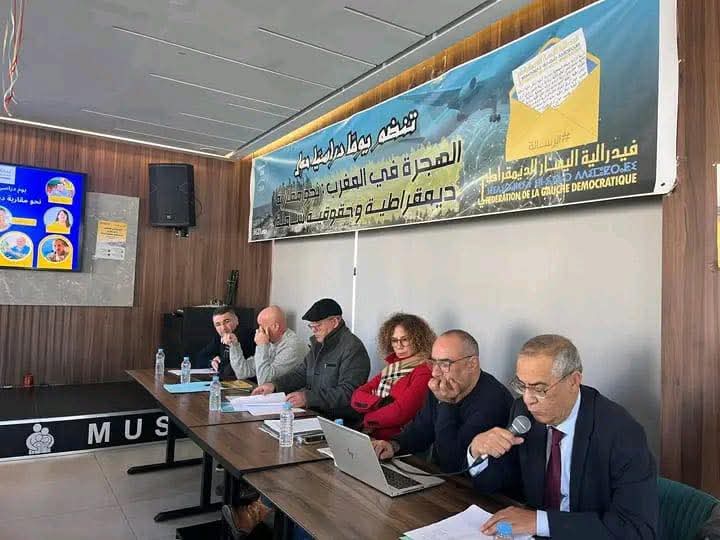
The Symbolic Choice of M’diq
During a national study day on migration held on January 24, 2026, Abdeslam El Aziz stated that the choice of M’diq for this event was not neutral. It was a politically significant decision: the city, located just a few kilometers from "occupied" Ceuta, illustrates the gaping chasm between a marginalized South and a fortified North. For him, this region is a theater of human tragedies where Moroccan youth, driven by unemployment and a lack of prospects, risk their lives against barbed wire or at sea.
Sovereignty and Colonial Borders
The Secretary-General of the FGD reaffirmed the party's consistent position: Ceuta, Melilla, and the adjacent islands are occupied Moroccan territories.
A Persistent Colonial Legacy: These enclaves are not merely historical vestiges, but a political reality that undermines national sovereignty.
Flashpoints of Tension: These borders transform the region into zones of permanent conflict and contribute directly to migratory tragedies.
Liberation and Democracy: The "liberation" of these territories is inseparable from the struggle for democracy, spatial justice, and the construction of a Mediterranean space based on cooperation rather than militarization.
Critique of International and European Policies
Abdeslam El Aziz lambasted the current international climate:
The Rise of the Far-Right: The hardening of European policies and racist rhetoric are turning the Mediterranean into a "mass grave."
The "Border Guard" Role: He refuses to let countries of the South, including Morocco, bear the cost of the international system's failure by becoming mere "border guards" for Europe.
A Multidimensional Crisis: Migration is no longer a simple social phenomenon; it is the symptom of a profound political and economic crisis.
The Multiple Faces of Migration
The intervention highlighted two major aspects of the migratory crisis:
Irregular Migration: Described as a "cry of protest" against marginalization and the lack of social justice.
Brain Drain: A "dangerous hemorrhaging" that drains the country of its doctors, engineers, and researchers.
Moroccans Living Abroad: New generations face increasing discrimination and are deprived of full citizenship.
Reception in Morocco: El Aziz also pointed to the legal and social precariousness of migrants and refugees within Morocco, arguing that it does not befit a state that claims to place human rights at the heart of its policies.
Against Hate Speech
A serious warning was issued regarding the rise of hate speech and racism in Morocco, both in the public sphere and on social media. The exploitation of isolated incidents or sporting events to incite tension threatens social peace and contradicts Morocco's African identity.
Toward an Alternative Approach
In conclusion, Abdeslam El Aziz emphasized the failure of purely security-led approaches:
Militarization and forced deportations do not curb migration as long as structural causes persist.
He called for a break from the "border guard" logic and a comprehensive review of public policies.
The Solution: Linking the issue of migration to the democratic transition and the building of a genuine Social State that guarantees employment, dignity, and freedoms. The goal of this study day is to propose an alternative democratic vision that places the human being at the center, ensuring that Morocco is no longer a country that "forcibly exports its children."